
The Village of the Tomb-Makers
In the fortieth year of Ramesses the Great, a scribe in a walled village outside Thebes wrote forty names down a piece of limestone in black ink — and beside each one, in red, the reason that man had not come to work.
Lives Before Ours takes one city, in one era, and walks its ordinary life all the way through — the work, the food, the law, the streets, the hours after dark. Every film is read from what actually survives: parish registers and coroners’ rolls, household accounts, ration lists, excavation reports. Where the record runs out, we say so.
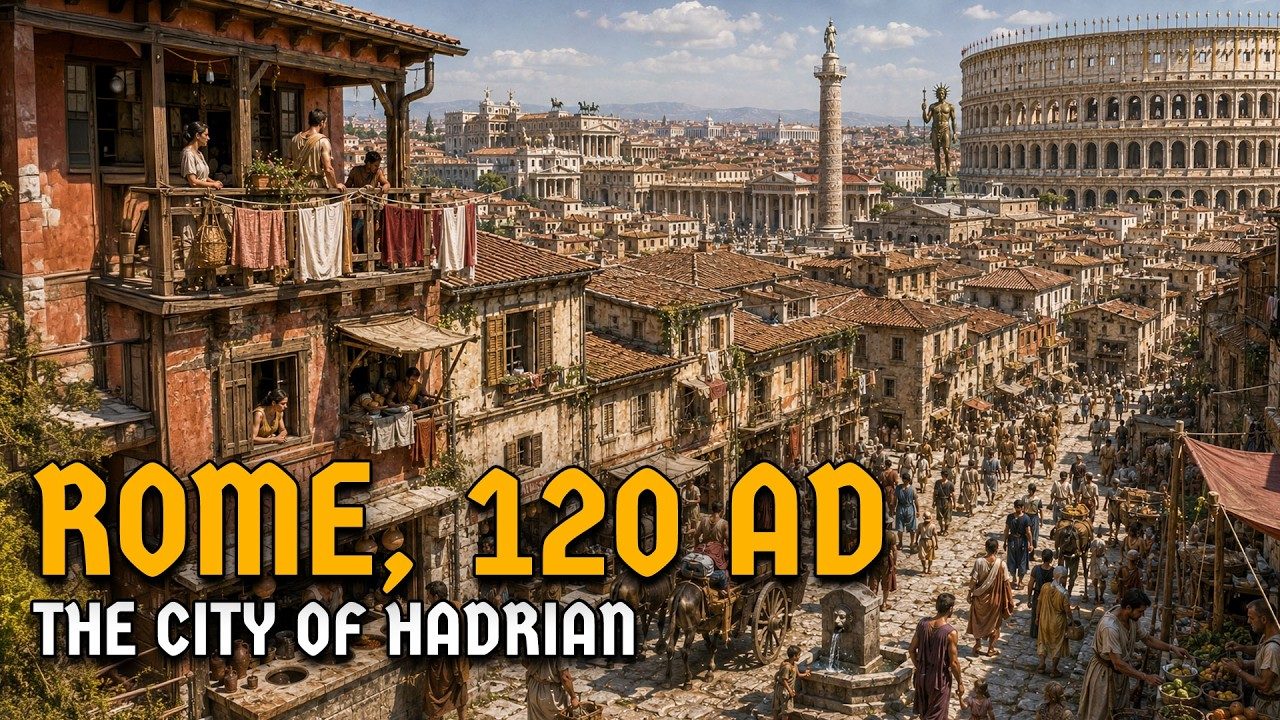
Most Romans slept four or five floors above the street, in a room with no kitchen, no chimney and no water. The building might burn down. It might simply fall down.
In the fortieth year of Ramesses the Great, a scribe in a walled village outside Thebes wrote forty names down a piece of limestone in black ink — and beside each one, in red, the reason that man had not come to work.
In the summer of 430 BC, the Parthenon was two years old. There were farmers asleep in the colonnades at the foot of the hill it stood on, and they had been there for more than a year.
Everything about Pompeii gets told through one afternoon in the year 79. This is about the other three thousand days.
In Roman Britain around AD 100, a woman named Claudia Severa wrote a birthday invitation in her own hand — and the wood survived.
The Roman bath has come down to us as a symbol of cleanliness. The reality, read from the ruins of Pompeii and the curse tablets of Bath, is murkier — the same warm water, used by hundreds through the day and changed only rarely.
Most Romans slept four or five floors above the street, in a room with no kitchen, no chimney and no water. The building might burn down. It might simply fall down.
The first sound of a Paris morning in 1256 was a man walking the streets shouting that the baths were hot.
The history books promised them grey gruel and little else. What the manor rolls, the rubbish pits, and their own bones actually reveal is a table far richer — and far stranger — than the legend ever allowed.
It is just before dawn in the London of 1340, the largest city in England — and not one of the tens of thousands waking inside its old Roman walls has ever seen a clock. This is the last ordinary generation before the Black Death, and tonight we walk it slowly, and quietly, until sleep takes you.
By law, the work could begin only after nine at night. A small gang would open a brick shaft in a London cellar, light a single candle, and climb down into the dark to empty the house’s cesspit by hand.
The hidden chemistry behind Tudor laundry — and why Henry VIII’s linen was whiter than anything we wash today. A long, slow documentary on the forgotten science of clean cloth in sixteenth-century England.
In 1665, during the Great Plague of London, Samuel Pepys called the parish nurses thieves. The records of one Westminster parish say he was wrong.
Edo in 1700 was almost certainly the largest city on earth. A million people, no sewers worth the name, and a warrior class that had not fought a war in eighty-five years.
On a single afternoon in 1841, a Welsh inspector found a 9-year-old boy named Phillip Phillips sitting alone in a coal mine, his face scarred from a fire he’d survived a year earlier — and he was still working.
In 1847, the poorest Londoners had between 52 and 175 cubic feet of air each. Prison regulations of the same decade required a thousand.
Court depositions, parish registers, ration lists, household accounts, building accounts, excavation reports, and the scholarship built on them. Numbers and named people are checked across at least two independent sources before they are spoken.
A morning is walked, not summarised. Where a scene is composite — a household, a workshop, a street — the chapter around it is threaded with real named anchors: a diarist, a witness, a document, a site that can be checked.
Popular history fills gaps quietly. These films do not. Where the deposition is silent, where the register stops, where the evidence is thin — the film says so and keeps going.
Each film carries its own bibliography — the works, archives and objects it was built from. They are collected here, film by film, so a claim can be traced back to where it came from.
One voice, no music stings, no sudden changes in volume, nothing shouted. A film runs between two and three and a half hours — long enough to fall asleep inside, and detailed enough to hold up if you stay awake for all of it. Most people meet both halves of that on different nights.
City films take one place in one era and cross the whole of it — homes and
work, rank and law, courtship, food, belief, childhood, death, the seasons, the night.
Single subjects open one thing slowly: a trade, a document, a habit — the gong
farmer’s shift, a birthday invitation written in AD 100, what a laundress did to keep a
king’s linen white.