Home/How we work
The standard the material has to meet before it is said out loud.
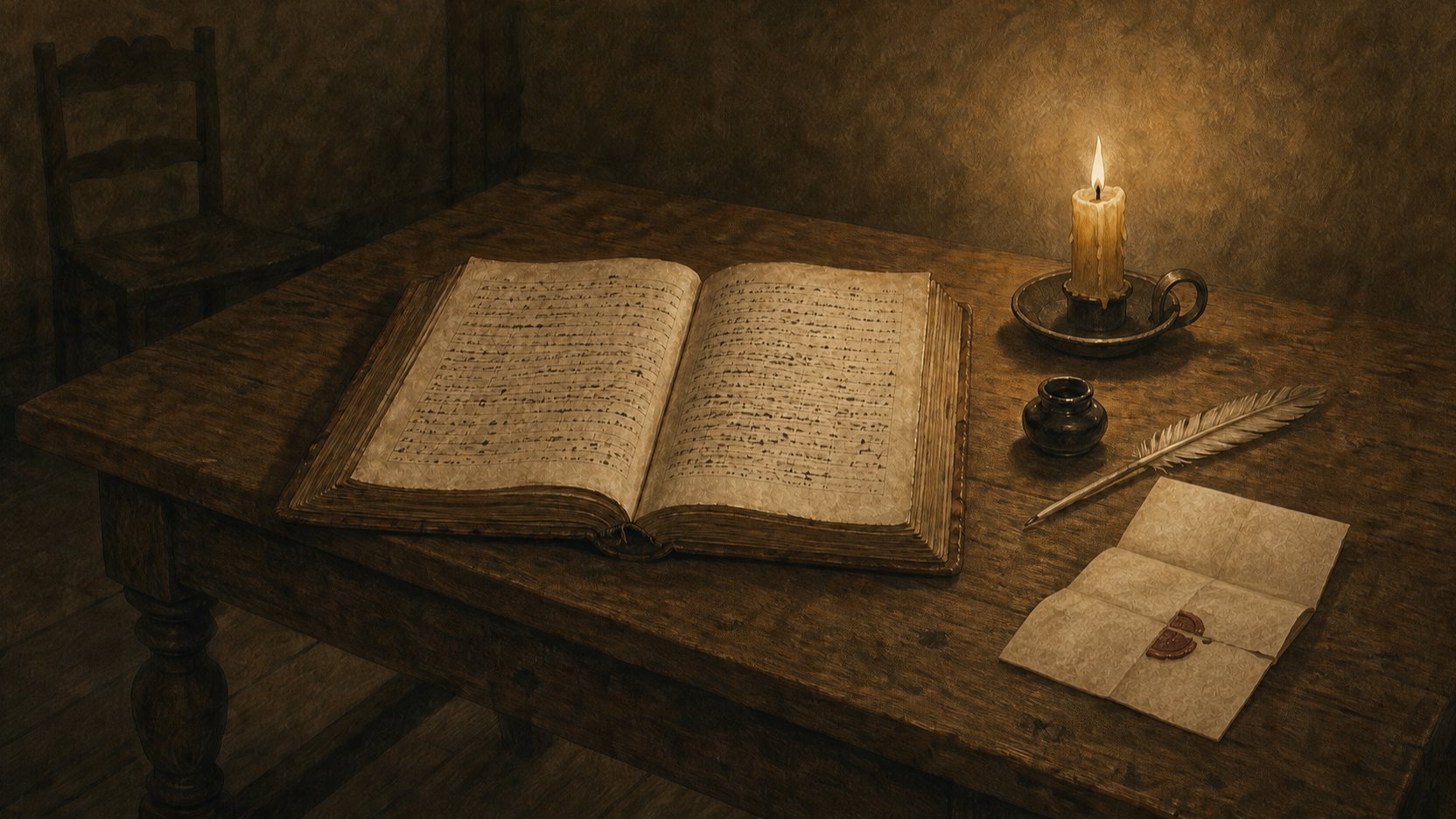
Every film starts as a pile of documents — a register, a court roll, a set of household accounts, and thirty years of argument about what they mean. What follows is what happens between that pile and the voice.
Three tiers, and the difference between them matters.
Primary sources carry the weight: court records and coroners’ rolls, parish registers and churchwardens’ accounts, ration lists, building accounts, contemporary letters and diaries, excavation and osteological reports. The films name them out loud — the workmen’s absence register on Ostracon BM EA 5634 outside Thebes, the Erechtheion building accounts at Athens, the St Margaret’s Westminster churchwarden’s accounts for 1665, the Children’s Employment Commission report of 1842 in which a nine-year-old collier called Phillip Phillips speaks for forty-three words and is then lost.
Credentialed scholarship is the second tier: university-press monographs, peer-reviewed journals, academic editions and translations. It is what turns a document into an argument, and it is where the last thirty years of revision live — which matters, because a lot of what “everyone knows” about the past is a Victorian guess that scholarship has since taken apart.
Reference works — encyclopaedias, museum catalogue entries, exhibition material — are used to orient and to cross-check. They are never the only support for a specific claim.
Numbers and named individuals are checked across at least two independent sources before they go into a script. Where they could not be, the film says which single source it rests on.
Popular history about ordinary people accumulates distortion, and most of it is cheerful. Standing rules:
If a claim is everywhere in popular accounts but cannot be traced to a primary or credentialed source, the film either says plainly that the popular version says one thing and the record another — or leaves it out.
A morning in 1740 is not summarised, it is walked: the candle, the cold floor, the weight of the bucket at the end of the carry. Some of those scenes are composite — a household, a workshop, a street assembled from what the period documents describe rather than from one surviving family’s paperwork. Where that is the case, the chapter around the scene is threaded with real named anchors: a diarist, a deposition, an excavated site, a named scholar’s reconstruction. The texture is period-accurate; the people who can be named, are.
It runs out constantly. Ordinary people were written down when they were taxed, baptised, buried, sued, or caught — which leaves long silences in between. Filling those silences quietly is the most common failure in this genre. These films name them instead: the deposition is silent on this, the register stops here, nobody wrote down the number and we should not pretend otherwise.
The sources. Every film carries its list, and all of them are collected on one page — currently 189 entries across 15 films. If a claim in a film matters to you, the intention is that you can go and check it.
No photograph exists of a Roman street at noon or a Welsh pit at shift change. The images in these films are reconstructions, made for the film and based on what the period evidence describes — buildings, dress, tools, light. They illustrate the record; they are not evidence themselves, and nothing in a script depends on them.
One voice, level, unhurried, mixed without music stings or volume jumps so that nothing in the last hour wakes anyone who fell asleep in the first. Chapter breaks are audible but soft. The runtime is not padding — it is the pace the material is meant to be met at.
Errors get made. When one is found it is fixed in public — see corrections.