
London·1850s
The City of the Great Exhibition
2 hr 53 min·13 August 2026·17 chapters·13 sources
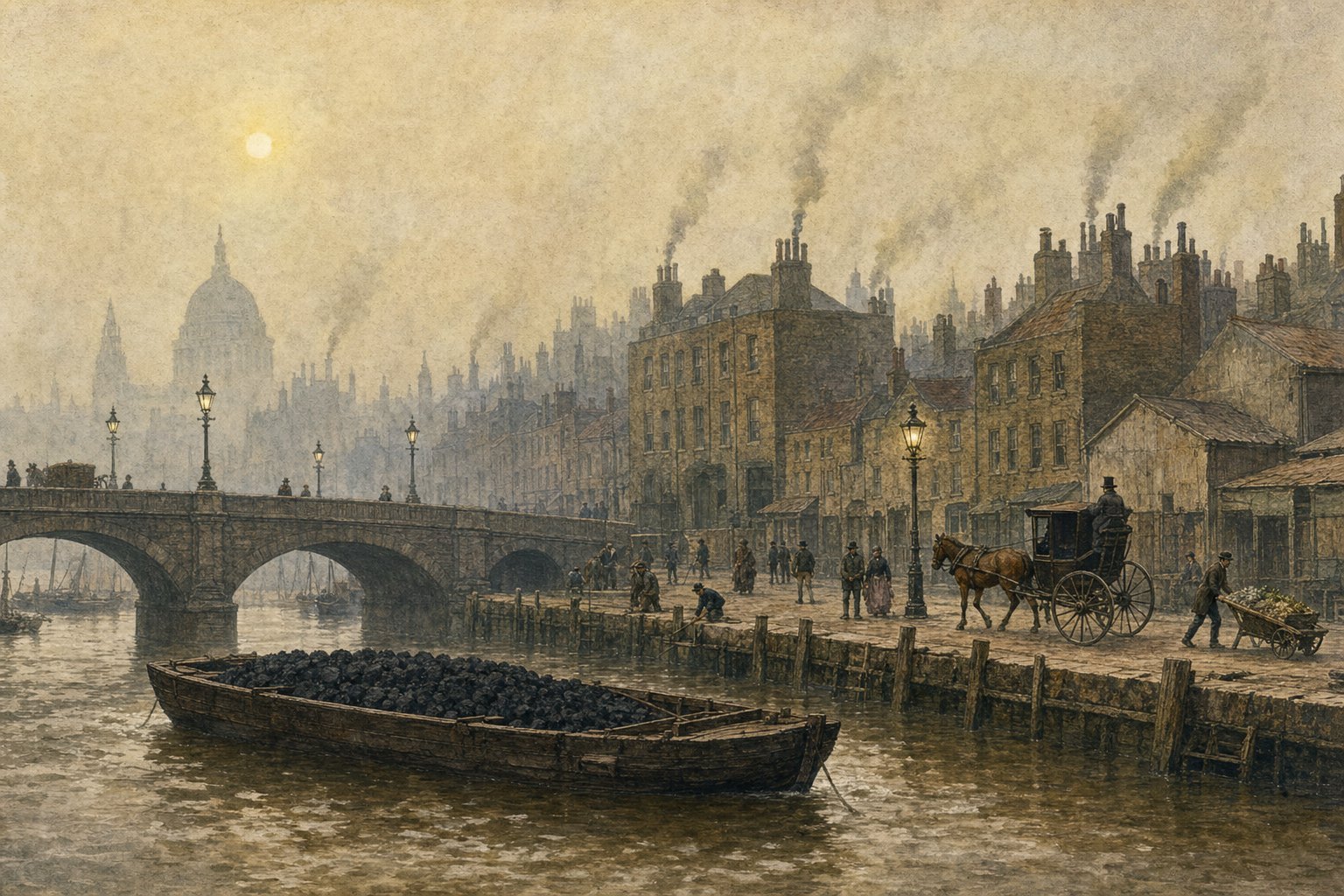
In 1847, the poorest Londoners had between 52 and 175 cubic feet of air each. Prison regulations of the same decade required a thousand.
Three hours inside the largest city the world had ever built, in the railway-and-gaslight decade of the Crystal Palace. Not a single day — the whole era, walked through by the aspects of living: the rookeries and the stucco terraces, the street trades and the dock gate, courtship and the law of husband and wife, gin palaces and chop-houses, alum in the bread and the Monday pawnshop, service below stairs, the Great Exhibition, Parliament, the Great Stink, the Broad Street pump, childhood, the workhouse, and the carts coming in from the market gardens before dawn. Every figure in it is sourced. Where the record runs out, we say so.
Chapters
17 · each opens the film at that pointSources
as published with the film- Henry Mayhew — London Labour and the London Poor (1851)
- Dr John Snow — On the Mode of Communication of Cholera, 2nd ed. (1855)
- Rev. Henry Whitehead — Special Report to the Cholera Inquiry Committee, St James’s, Westminster (1855)
- Arthur Hill Hassall — Food and its Adulterations (Longman, 1855)
- Thomas Beames — The Rookeries of London (1850; 2nd ed. 1852)
- The Diaries of Hannah Cullwick, ed. Liz Stanley — Munby Collection, Trinity College, Cambridge
- Barbara Leigh Smith — A Brief Summary in Plain Language of the Most Important Laws Concerning Women (1854)
- Caroline Norton — A Letter to the Queen (1855)
- Charles Dickens — “A Nightly Scene in London”, Household Words, 26 January 1856
- Census of Great Britain, 1851; Census of Religious Worship, compiled by Horace Mann (1854)
- Proceedings of the Old Bailey, 1850–1859
- Lee Jackson — Dirty Old London (Yale University Press, 2014)
- And let us know in the comments where you are listening from tonight: your city, your time zone. It is good to know how far a quiet hour has carried
Something wrong here? Tell us — corrections are made in public.