
Pompeii·AD 79
The Other Three Thousand Days
2 hr 43 min·27 July 2026·17 chapters·26 sources
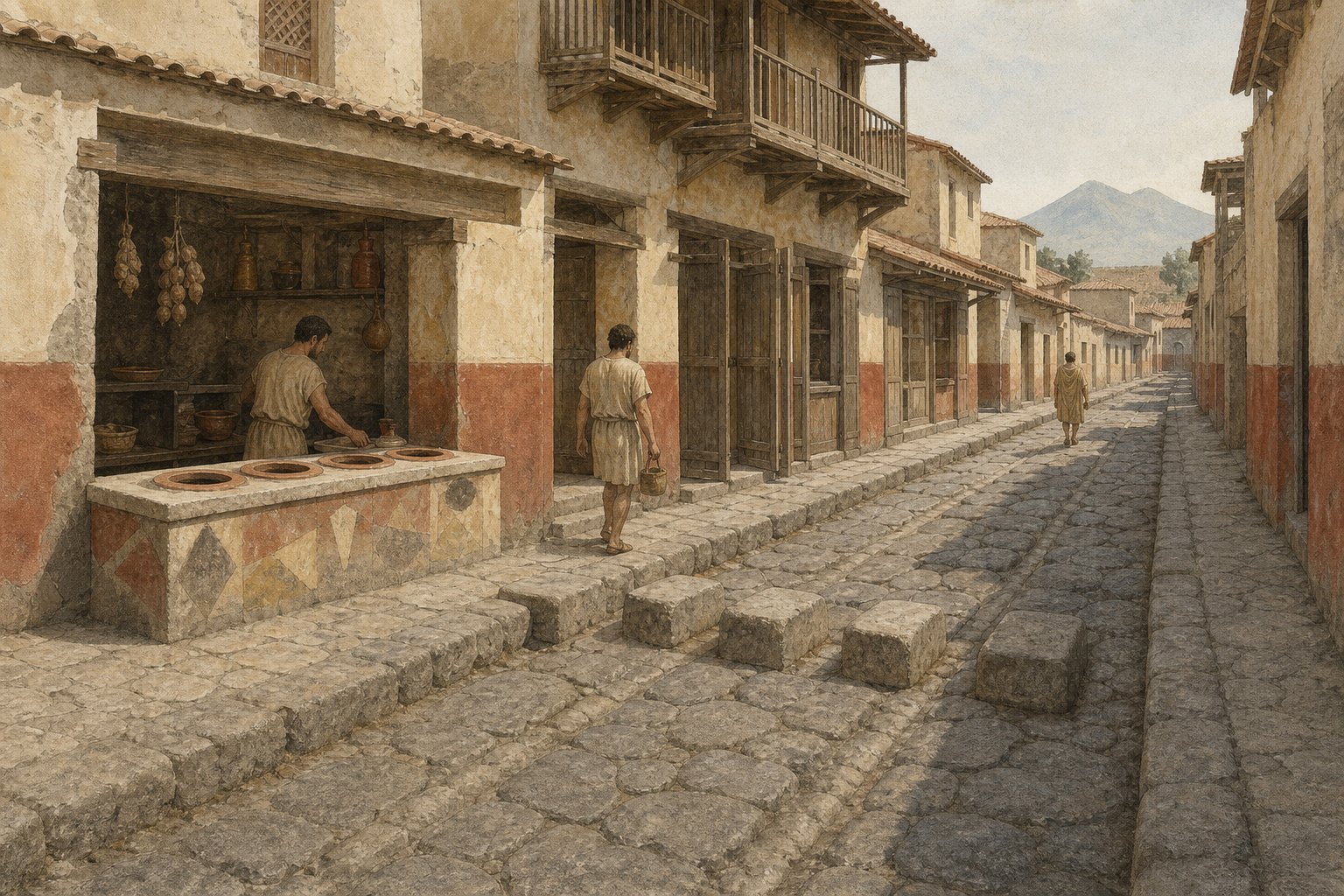
Everything about Pompeii gets told through one afternoon in the year 79. This is about the other three thousand days.
Nearly three hours of the ordinary life of a Roman town, read slowly from the record: 158 counters selling hot food to people who had nowhere to cook, roughly 2,500 election notices painted over one another, a moneylender’s interest scratched on a wall in July, two thousand vines growing inside the town walls, and a milling room with bars on the windows and no door to the street. Pompeii in the 70s AD was not a town frozen at its peak — it was seventeen years into a rebuild, with its water system opened up for repair and its biggest bath-house still unfinished. Everything here is sourced. Where the evidence runs out, we say so.
Low voice, no music stings, nothing raised. Built to be listened to on the way to sleep, and to hold up if you stay awake.
Also here: why the most famous date in Roman history is currently under revision, and what happened to this town for four hundred years after everyone stopped paying attention.
Chapters
17 · each opens the film at that pointSources
as published with the film- Primary
- Tacitus, Annals 14.17 (the riot of AD 59)
- Seneca, Natural Questions VI (the earthquake of AD 62)
- Suetonius, Vespasian 23 (the tax on urine)
- Corpus Inscriptionum Latinarum IV (the Pompeian wall inscriptions)
- CIL X 846 (the Temple of Isis plaque)
- the wax tablets of Lucius Caecilius Iucundus
- Scholarship
- Mary Beard, Pompeii: The Life of a Roman Town
- Andrew Wallace-Hadrill, Houses and Society in Pompeii and Herculaneum
- Eric Poehler, The Traffic Systems of Pompeii
- Miko Flohr, The World of the Fullo
- Sarah Levin-Richardson, The Brothel of Pompeii
- Kristina Milnor, Graffiti and the Literary Landscape in Roman Pompeii
- Estelle Lazer, Resurrecting Pompeii
- James L. Franklin Jr., Pompeii: The Electoral Programmata, Campaigns and Politics, A.D. 71–79
- Thomas McGinn, The Economy of Prostitution in the Roman World
- Ellis, Emmerson and Dicus, The Porta Stabia Neighborhood at Pompeii
- the garden archaeology of Wilhelmina Jashemski
- Nicolas Monteix on the bakeries
- Robert I. Curtis on garum
- Lawrence Bliquez and Ralph Jackson on the surgical instruments
- Excavation and recent finds
- Parco Archeologico di Pompei: the Regio V counter (2019–20), the room of the enslaved at Civita Giuliana (2021, with further finds 2025), the Regio IX excavations and the milling room (2023), the tomb of Marcus Venerius Secundio at the Porta Sarno (2021), and the evidence for the reoccupation of the town (2025)
- the unfinished construction site at Domus IX 10, 1, published with MIT
- ancient DNA from the plaster casts, Current Biology (November 2024)
Something wrong here? Tell us — corrections are made in public.