
London·14th–17th c.
The Gong Farmer
2 hr 16 min·10 June 2026·15 chapters·9 sources
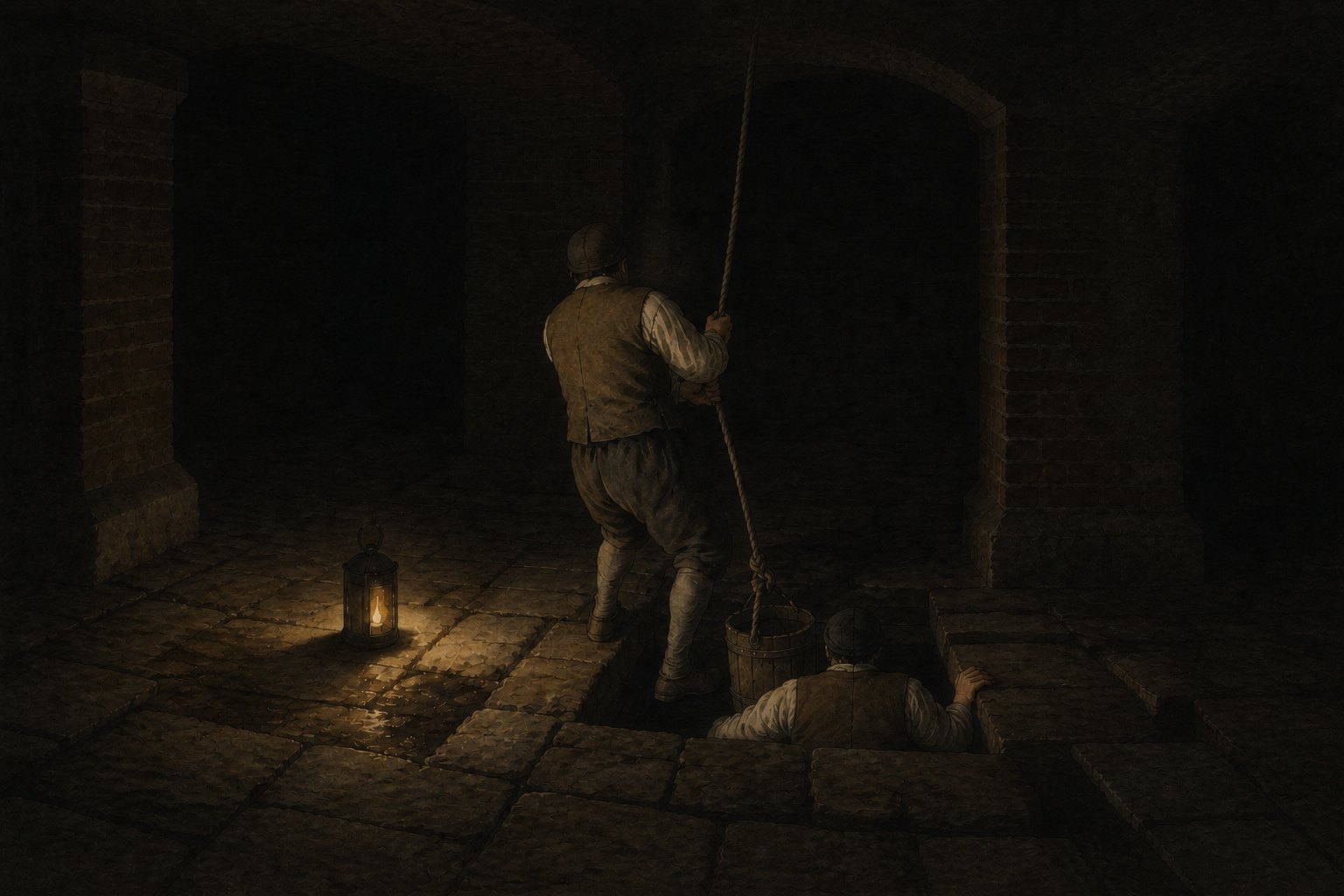
By law, the work could begin only after nine at night. A small gang would open a brick shaft in a London cellar, light a single candle, and climb down into the dark to empty the house’s cesspit by hand.
This is the story of the gong farmers — the night-soil men who kept medieval and early-modern London livable, one pit at a time. Across a single composite night, drawn from parish accounts, the City coroners’ rolls, and the diary of Samuel Pepys, we follow the descent into the dark, the foul air that could kill the man in the pit and the one who climbed down to save him, the fee that equalled several days of a craftsman’s pay, and the people named in the record who did the work the city needed and chose to forget. Told slowly, for rest.
Chapters
15 · each opens the film at that pointSources
as published with the film- Ernest L. Sabine, “Latrines and Cesspools of Mediaeval London,” Speculum (1934)
- Calendar of Coroners’ Rolls of the City of London, 1300–1378, ed. R.R. Sharpe (1913)
- Calendar of Letter-Books of the City of London: Letter-Book B, ed. R.R. Sharpe
- Henry Mayhew, London Labour and the London Poor (1851)
- The Diary of Samuel Pepys, ed. R. Latham & W. Matthews (1970–83)
- Carole Rawcliffe, Urban Bodies: Communal Health in Late Medieval English Towns (Boydell, 2013)
- The Common Hour is a sleep documentary channel about the ordinary past — the labourers, households, and forgotten trades that filled the hours between the famous ones
- Based on surviving primary sources and current historical scholarship. Where the record is silent, the silence is named
- #SleepDocumentary #MedievalLondon #History #TheCommonHour #SocialHistory #TudorEngland #HistoryForSleep
Something wrong here? Tell us — corrections are made in public.