
Thebes·1250 BC
The Village of the Tomb-Makers
2 hr 46 min·7 August 2026·17 chapters·15 sources
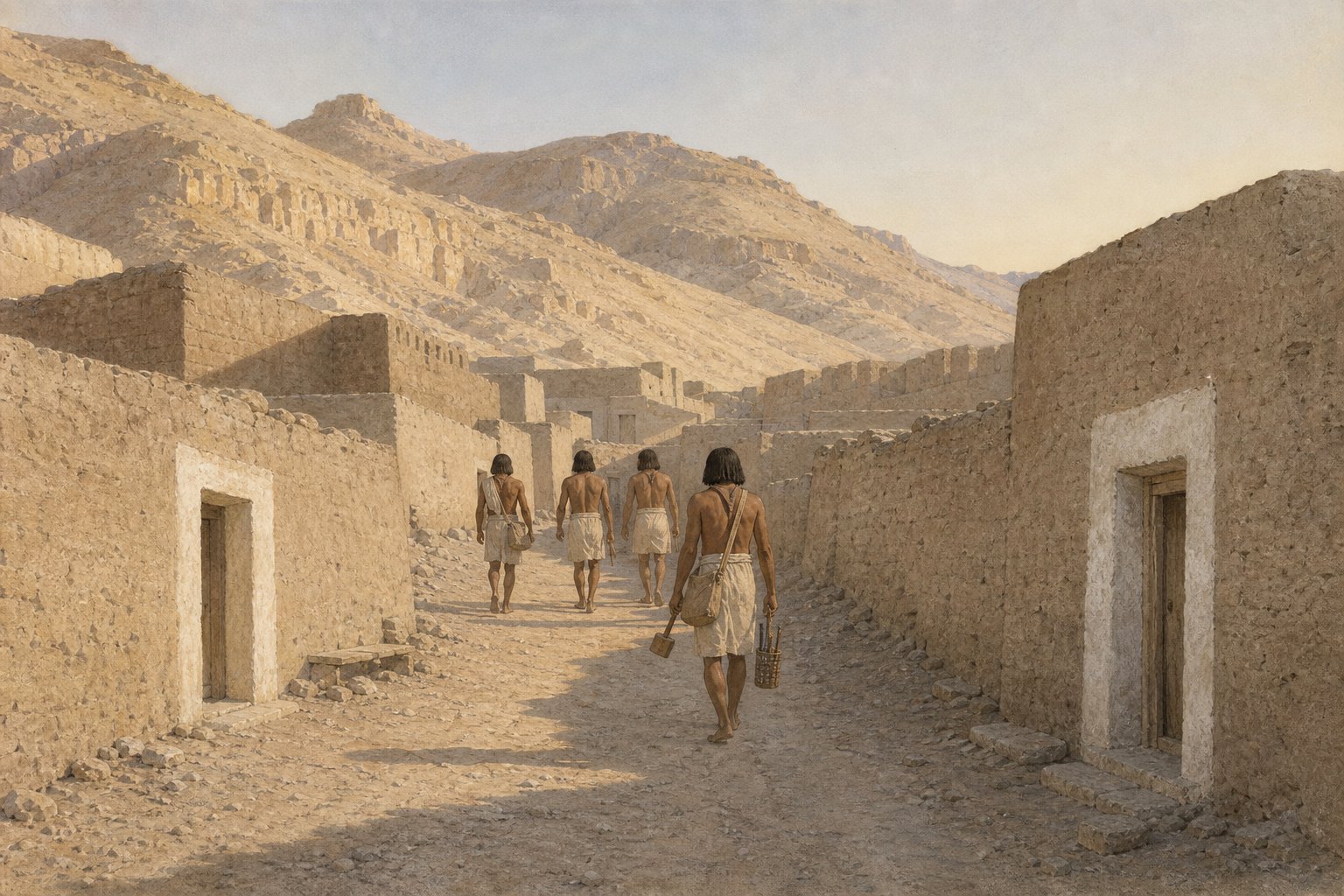
In the fortieth year of Ramesses the Great, a scribe in a walled village outside Thebes wrote forty names down a piece of limestone in black ink — and beside each one, in red, the reason that man had not come to work.
That stone is still readable. This is the world it came out of.
Three hours of slow, sourced documentary on ordinary life in Egypt around 1250 BC. Not pharaohs and gold — the men who cut the royal tombs and the women who ground their flour. What they ate, what they were paid, who they married, what happened when it went wrong, what medicine could and could not reach, and what they did when somebody died. Everything here is read from surviving evidence: ration lists, court records, love poems, medical papyri, a dream manual, and an attendance register kept in two colours of ink. Narrated quietly, at a pace meant for the end of the day.
Chapters
17 · each opens the film at that pointSources
as published with the film- Ostracon BM EA 5634, the workmen’s absence register, year 39–40 of Ramesses II — British Museum
- The Papyrus of Ani, BM EA 10470 — British Museum
- Papyrus Chester Beatty I (love songs), Chester Beatty Library, Dublin
- Papyrus Chester Beatty III, the Dream Book, BM EA 10683
- Papyrus Lansing, and the Middle Kingdom Satire of the Trades
- The Ebers Papyrus and the Edwin Smith surgical papyrus
- Turin Stela 50066 — Museo Egizio
- Bernard Bruyère, excavations at Deir el-Medina, 1922–1951
- Jac. J. Janssen, Commodity Prices from the Ramessid Period (1975)
- Anne Austin, on health care and tattooing at Deir el-Medina; with Marie-Lys Arnette, “Of Ink and Clay” (2022)
- Delwen Samuel, on Egyptian baking and brewing, Science (1996)
- Kathrin Gabler, Who’s Who Around Deir el-Medina (2018)
- Barry Kemp, on the Ramesseum storerooms
- Kent Weeks and the Theban Mapping Project, KV5
- Ghalioungui, Khalil and Ammar, “On an Ancient Egyptian Method of Diagnosing Pregnancy,” Medical History (1963)
Something wrong here? Tell us — corrections are made in public.