
Edo (Tokyo)·1700
The Largest City on Earth
2 hr 28 min·17 August 2026·17 chapters·14 sources
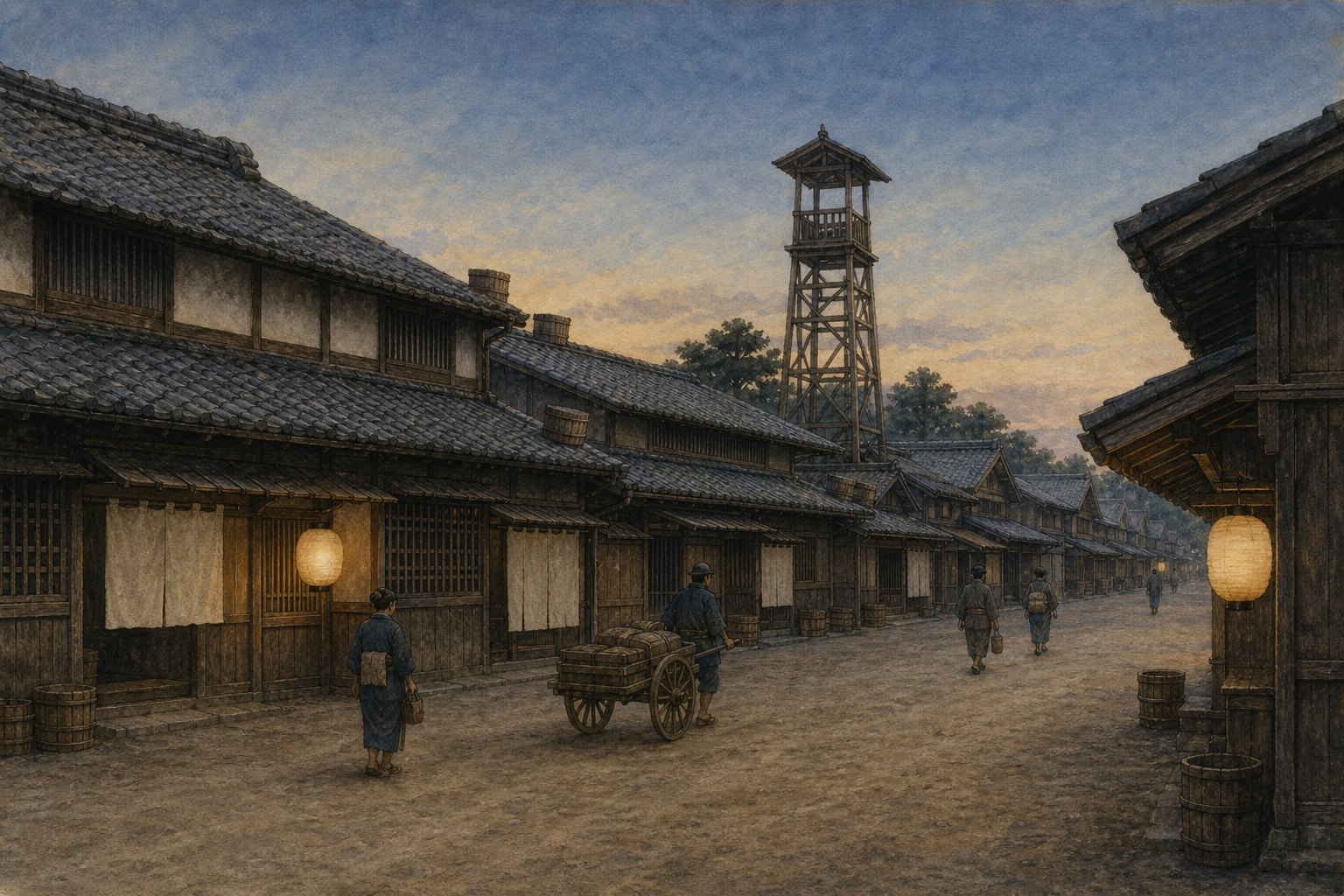
Edo in 1700 was almost certainly the largest city on earth. A million people, no sewers worth the name, and a warrior class that had not fought a war in eighty-five years.
Three hours inside it, read slowly, for sleep.
This is an unhurried walk through the ordinary life of one city in one year — the nine-foot rooms people actually slept in, the drinking water that arrived by wooden pipe from twenty-seven miles away, the waste that farmers came to the door and paid money for, the fires nobody attempted to put out, the printed book that listed the women of the pleasure quarter by name and price, and the coin that the government had quietly made worse five years earlier. Everything here is drawn from the record, and the principal sources are listed below. Where the record runs out, we say so rather than filling it in. No music stings, no raised voices, no cliffhangers. It is meant to be listened to in the dark and slept through.
Chapters
17 · each opens the film at that pointSources
as published with the film- Engelbert Kaempfer, The History of Japan (1727) — in the edition by Beatrice Bodart-Bailey, Kaempfer’s Japan: Tokugawa Culture Observed (University of Hawai’i Press, 1999)
- Beatrice M. Bodart-Bailey, The Dog Shogun: The Personality and Policies of Tokugawa Tsunayoshi (Hawai’i, 2006)
- Constantine N. Vaporis, Tour of Duty: Samurai, Military Service in Edo, and the Culture of Early Modern Japan (Hawai’i, 2008)
- Susan B. Hanley, Everyday Things in Premodern Japan
- Amy Stanley, Selling Women: Prostitution, Markets, and the Household in Early Modern Japan (California, 2012)
- Nam-lin Hur, Death and Social Order in Tokugawa Japan: Buddhism, Anti-Christianity, and the Danka System (Harvard, 2007)
- Fabian Drixler, Mabiki: Infanticide and Population Growth in Eastern Japan, 1660–1950 (California, 2013)
- Gerald Groemer, “The Creation of the Edo Outcaste Order,” Journal of Japanese Studies
- Timothy D. Amos, Caste in Early Modern Japan: Danzaemon and the Edo Outcaste Order
- David L. Howell, on status and identity in early modern Japan
- Ronald P. Dore, Education in Tokugawa Japan
- Ihara Saikaku, This Scheming World (1692)
- Tokyo Metropolitan Library, Edo Tokyo Digital Museum; Tokyo Metropolitan Government Waterworks
- A note on dates: 1700 falls inside the Genroku era, under the fifth shogun, Tokugawa Tsunayoshi. Anything belonging to a later century — the food stalls, the townsmen’s fire brigades, the geisha — has been deliberately kept out
Something wrong here? Tell us — corrections are made in public.